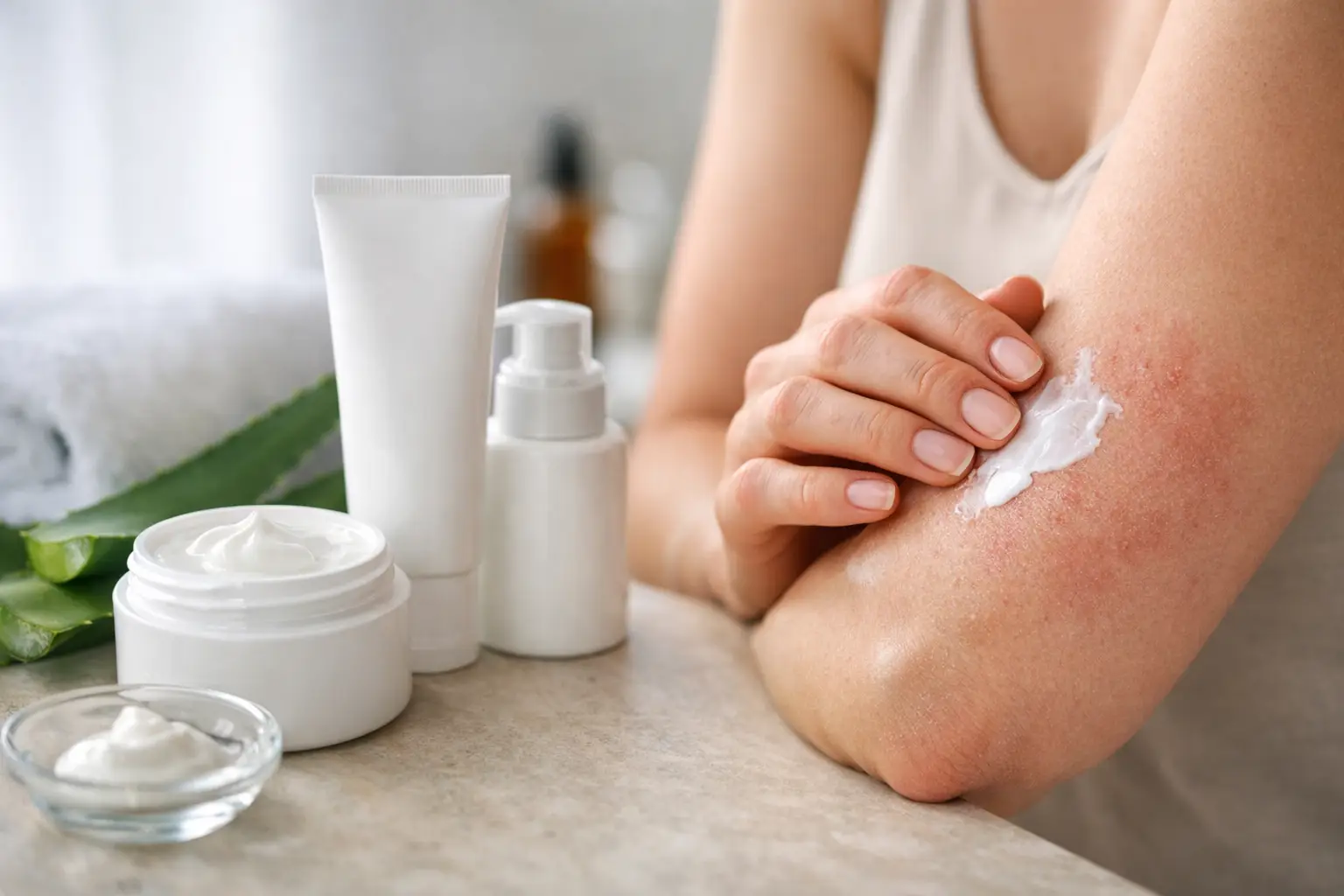
Dry, reactive skin rarely needs a more complicated routine. It needs fewer points of friction. A useful barrier cream review for eczema-prone skin should therefore look beyond a dramatic before-and-after claim and ask a simpler question: can this formula protect compromised skin well enough that you can use it consistently?
For eczema-prone skin, the best product is not always the richest, most natural-looking, or most expensive cream on the shelf. Formula compatibility, where you use it, and whether you can tolerate its texture day after day matter more. A barrier cream is a support product, not a cure for eczema. Used thoughtfully, it can help reduce the cycle of dryness, tightness, and irritation that makes skin harder to manage.
What a barrier cream is meant to do
The outermost layer of skin holds water in and helps keep irritants out. With eczema-prone skin, that barrier is often less efficient. Water escapes more easily, and ordinary exposures such as hot water, soap, sweat, fabric friction, or dry air may feel disproportionately irritating.
A barrier cream is designed to reinforce this protective function. Most effective formulas do this through a combination of three approaches: humectants attract water, emollients smooth rough skin, and occlusives reduce water loss. The balance matters. A cream that contains only lightweight humectants may feel pleasant but may not provide enough protection for severely dry hands. A very occlusive ointment can be excellent overnight, yet feel unworkable under clothing in humid weather.
This is why a barrier cream review should not stop at an ingredient list. It should consider real use: hands washed repeatedly, cheeks exposed to wind, elbows rubbed by clothing, or skin that becomes itchy after a shower.
How to assess a barrier cream for eczema-prone skin
Start with the formula’s purpose
Look for a formula that has a clear barrier-support role rather than a long list of decorative extras. Petrolatum, dimethicone, mineral oil, ceramides, glycerin, squalane, and colloidal oatmeal can each have a place in a well-considered formula. None is automatically right for every person, but each has a recognizable function.
Petrolatum is highly effective at limiting water loss and is often useful on cracked hands, feet, and very dry patches. Dimethicone can create a lighter protective layer and may suit daytime use, especially when frequent handwashing is part of the problem. Ceramides are skin-identical lipids that can support the barrier, while glycerin helps bring water into the upper skin layers.
Ingredient count alone is not a measure of quality. A short formula can be purposeful. A longer formula can also be well designed. The better question is whether every component earns its place for sensitive skin.
Treat fragrance as a meaningful trade-off
A scented cream can make application feel more pleasant, but fragrance is a common source of avoidable irritation for eczema-prone skin. This includes essential oils and botanical extracts used primarily for aroma. Natural origin does not guarantee skin compatibility.
For people with recurring flares, a fragrance-free formula is usually the more disciplined choice. That does not mean every botanical ingredient is a problem, or that every fragranced product will cause a reaction. It means the risk-reward balance changes when the skin barrier is already vulnerable. A barrier cream does not need to smell like a spa product to do its job well.
Judge texture in the context of your routine
Texture determines adherence. If a cream feels sticky enough to make you avoid using it, its theoretical benefits become less relevant. The right texture depends on body area and climate.
A lighter cream or lotion may be sufficient for daytime body use, especially in warm, humid conditions. A dense cream may suit dry legs, arms, and hands. An ointment-like product is often most useful for small, very dry areas or as the final layer at night. Facial eczema can require a lighter option, particularly for those also prone to clogged pores or breakouts.
There is no prize for choosing the heaviest product. Choose the level of protection your skin needs at that moment.
The ingredient claims that deserve a closer look
Terms such as “clean,” “dermatologist tested,” “hypoallergenic,” and “natural” can be useful only when paired with specifics. They do not replace a clear formula or predict how your skin will respond.
Be especially cautious with barrier creams that rely on strong cooling sensations, high amounts of alcohol, or multiple active ingredients intended to exfoliate, brighten, or rapidly transform the skin. Those features may serve another concern, but they can be poorly matched to a disrupted barrier.
A restrained formula is not boring. It is often a practical advantage. Calmora Natural approaches sensitive-skin care with this principle in mind: fewer, better products selected for a defined function rather than unnecessary complexity.
Match the cream to the area that needs support
A single barrier cream can work across the body, but it does not have to be your answer for every surface. Hands, eyelids, face, and feet experience very different conditions.
Hands often benefit from a protective cream after washing and before exposure to detergents or dry air. Keep one where the routine happens, not in a cabinet you will forget. For the body, applying cream within a few minutes of bathing helps hold onto the water already present in the skin. Pat dry rather than rubbing vigorously, then apply generously while the skin is still slightly damp.
For the face, use less product and introduce it carefully. The skin around the eyes can be especially reactive, and facial redness or scaling has several possible causes beyond eczema. If a cream repeatedly stings, causes bumps, or leaves the area more inflamed, stop using it rather than trying to push through.
A practical way to test a new cream
Even a carefully formulated barrier cream can be wrong for an individual. Testing slowly is more useful than applying a new product everywhere during an active flare.
Apply a small amount to a limited area of intact skin once or twice daily for several days. Observe more than immediate sensation. Some products feel soothing at first but lead to itching, persistent burning, new bumps, or increased redness later. If the test area remains comfortable, expand use gradually.
When evaluating a product, keep the rest of your routine steady where possible. Introducing a new cleanser, serum, detergent, and barrier cream in the same week makes it difficult to identify what helped or harmed. Sensitive skin responds better to controlled changes than to constant product rotation.
What realistic results look like
A well-matched barrier cream may leave skin feeling less tight after cleansing, reduce visible flaking over time, and make daily triggers easier to tolerate. It may also reduce the urge to scratch by improving comfort. These are meaningful outcomes, even if they are less dramatic than a promise of instant repair.
It may not be enough on its own during a significant eczema flare. Cracked, weeping, crusted, painful, or rapidly spreading skin needs clinical attention. The same is true if itching disrupts sleep or if symptoms do not improve despite a consistent, gentle routine. A dermatologist can help distinguish eczema from infection, contact allergy, psoriasis, seborrheic dermatitis, or other conditions that need a different approach.
The better standard for a barrier cream review
The strongest barrier cream is the one that fits your skin, your environment, and your actual habits. It should have a clear purpose, a tolerable texture, and a formula that does not create unnecessary risk for already reactive skin.
Let consistency be the measure. A simple cream applied at the right moments can be more valuable than a crowded routine built around promises your skin never asked for.
Leave a Reply