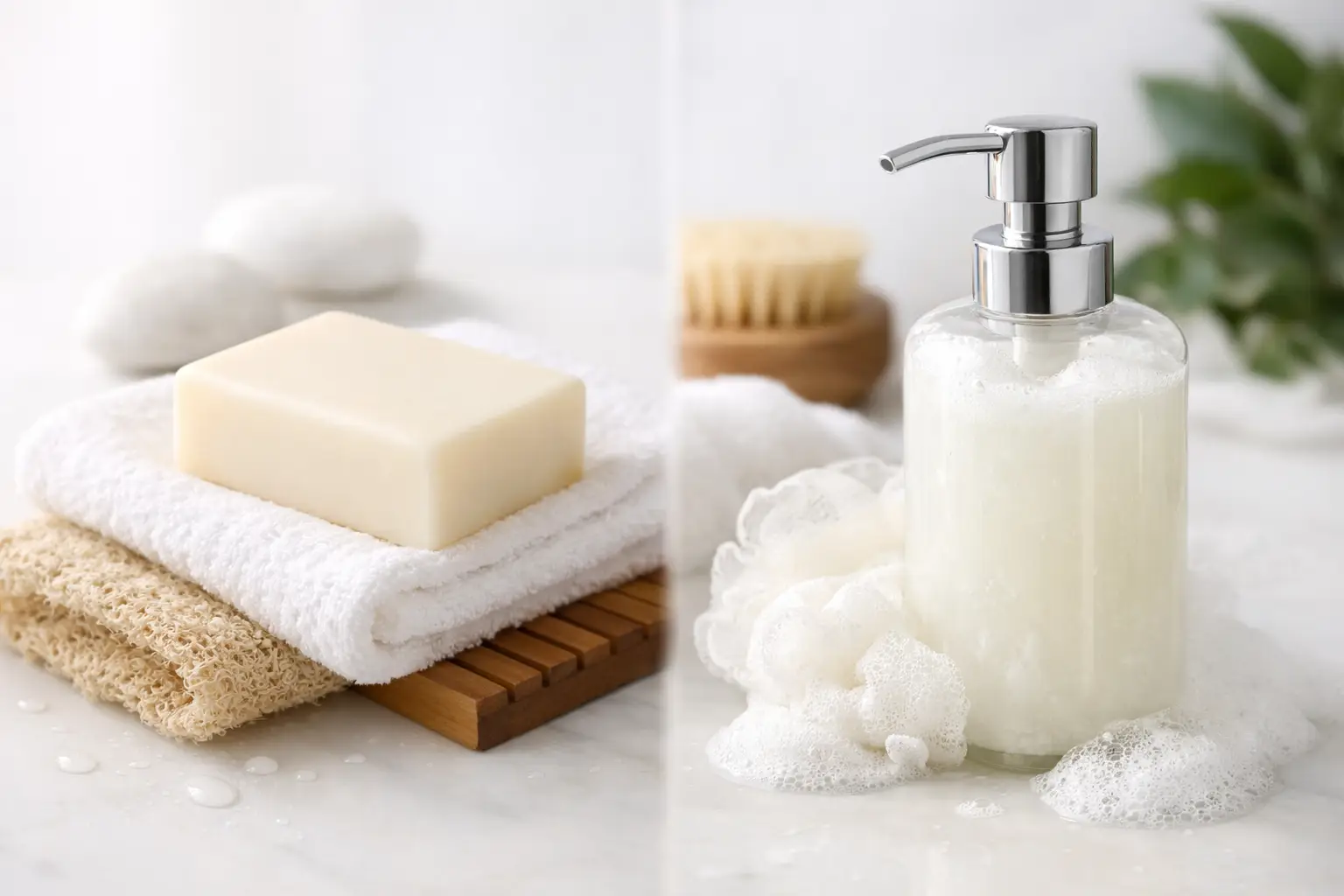
If your skin feels tight after a shower, the bar soap vs body wash question stops being theoretical. It becomes practical, fast. The right cleanser can help maintain comfort, reduce irritation, and make the rest of your routine simpler. The wrong one can quietly keep dryness, itch, or congestion going.
This is not a category where one format wins by default. A bar can be excellent. A body wash can be excellent. Both can also be overly harsh, heavily fragranced, or built around marketing rather than skin function. What matters is how the product is formulated, how your skin behaves, and what you need your cleanser to do every day.
Bar soap vs body wash: what actually changes?
At the skin level, both bar soap and body wash are there to remove sweat, oil, odor, sunscreen, and daily buildup. The difference is usually in cleansing system, water content, and how easy it is to include supporting ingredients.
Traditional soap bars are made through saponification. They tend to cleanse effectively, but depending on the formula, they can also feel more stripping, especially on dry or compromised skin. That does not mean every bar is harsh. Many modern bars are formulated with milder surfactants or conditioning ingredients and behave very differently from old-fashioned soap.
Body wash is typically a liquid cleanser built with surfactants rather than classic soap. This format often gives formulators more flexibility. It can be easier to balance cleansing with humectants, emollients, and skin-soothing ingredients. For people with sensitivity, eczema-prone skin, or barrier disruption, that flexibility can matter.
Still, the format alone tells you very little. A heavily fragranced body wash can be more irritating than a well-formulated bar. A basic syndet bar can be gentler than a foamy gel designed to feel “deep cleaning.” The label matters less than the formula logic.
Which is better for dry or sensitive skin?
If your skin runs dry, reactive, or eczema-prone, body wash often has the edge. Not because liquid is inherently superior, but because gentle liquid cleansers are more commonly designed around barrier support. They may include glycerin, mild surfactants, and fewer alkalizing effects than traditional soap.
That said, some bars are very suitable for sensitive skin. The better ones avoid aggressive fragrance, unnecessary essential oils, and harsh cleansing systems. They cleanse without leaving that squeaky finish that many people mistake for cleanliness. Skin does not need to feel stripped to be clean.
For dry or sensitive skin, the more useful question is not bar or wash. It is whether the cleanser leaves your skin calm after rinsing. If you regularly step out of the shower feeling tight, itchy, or warm, your cleanser may be too much.
Short ingredient lists can help, but short is not automatically better. Purpose matters more than minimalism for its own sake. A disciplined formula with a few functional ingredients is often a better choice than a long ingredient list built around sensory appeal.
What about oily or acne-prone skin?
Oily skin is often over-cleansed. Body acne is often over-dried. That can create a cycle where the skin feels temporarily clean but becomes irritated, dehydrated, or more reactive over time.
In bar soap vs body wash for oily skin, either can work if the cleanser removes sweat and oil without pushing the skin into rebound behavior. If you are acne-prone on the chest, shoulders, or back, a body wash may be easier to formulate with targeted actives. It is also easier to spread evenly across larger areas. But a bar can still work well if it is non-stripping and kept hygienic between uses.
The key is not choosing the strongest option. It is choosing the one you can use consistently without creating dryness or friction. For acne-prone skin, irritation is rarely helpful. A calmer skin barrier usually responds better over time than skin that is constantly being pushed.
Convenience, hygiene, and everyday use
This is where preferences become practical. Bars are simple, compact, and travel well. They use less water in manufacturing and usually require less packaging. For many people, that makes them the more efficient choice.
Body wash tends to be easier in shared showers, easier to dose, and often more comfortable for people who do not want friction from rubbing a bar directly on the skin. If you use a washcloth or your hands, the product can be distributed with less drag, which matters if your skin is irritated or easily inflamed.
Hygiene concerns around bar soap are often overstated in normal household use. A bar that drains properly and is stored dry between showers is generally fine. The bigger issue is not contamination. It is whether the bar becomes messy, soft, or inconvenient enough that you use more than needed or stop enjoying the routine.
A useful product is one you will keep using. Compliance matters more than category loyalty.
Cost and sustainability are part of the decision
Bars often look better on value. They are concentrated, longer-lasting, and usually packaged with less plastic. If you are trying to reduce packaging waste or simplify your bathroom, a well-made bar makes sense.
Body wash can still be a rational choice, especially if your skin needs a more specialized formula. Paying more for a cleanser that supports barrier comfort may save you from compensating with heavier moisturizers or repeated trial and error.
There is a broader principle here. Sustainable choices work best when they are also realistic. If a bar consistently leaves your skin dry and pushes you toward more products, it may not be the most efficient system for you. Fewer, better products only works when each product is doing its job.
How to choose between bar soap and body wash
Start with your skin, not the trend cycle.
If your skin is dry, sensitive, mature, menopausal, or eczema-prone, begin with a mild body wash or a very gentle syndet-style bar. Look for formulas that prioritize low irritation and barrier support. Avoid strong fragrance if your skin is already sending clear signals.
If your skin is normal to oily and not especially reactive, you have more flexibility. A bar may give you the simplicity and low-waste format you want without compromising skin comfort. Just pay attention to how your skin feels after a week or two of use.
If body odor, heavy sweat, or frequent showering is part of your routine, the best cleanser is the one that handles repeat use without causing dryness. People in humid climates often wash more often, which makes cleanser gentleness more important, not less.
And if you are managing body breakouts, folliculitis, or recurring irritation, a body wash may be easier to pair with specific actives and more controlled application. In those cases, format can support consistency.
A quick label check that helps
You do not need to decode every ingredient. A few signals are enough.
Look for cleansers that describe themselves in plain terms rather than dramatic ones. “Moisturizing,” “fragrance-free,” or “for sensitive skin” are more useful starting points than anything promising a total reset. Be cautious with intense perfume, heavy essential oil blends, or products designed to feel aggressively purifying.
If the product leaves a lasting fragrance trail, it may also leave a higher irritation burden, especially on already stressed skin. If it produces a lot of foam, that is not automatically bad, but foam itself is not a measure of quality.
Calmora Natural’s approach is useful here: fewer decisions, clearer function, no exaggerated claims. That is the right mindset for cleansing. Choose for compatibility, not excitement.
The better answer is usually the quieter one
Bar soap vs body wash is not really a debate about which format is best. It is a decision about fit. Your skin barrier, your shower habits, your climate, and your tolerance for fragrance all matter more than category assumptions.
A good bar is a good product. A good body wash is a good product. The better choice is the one that cleans effectively, respects your skin, and does not force the rest of your routine to work harder. If your current cleanser leaves your skin calm enough that you stop thinking about it, that is usually a sign you chose well.
Leave a Reply