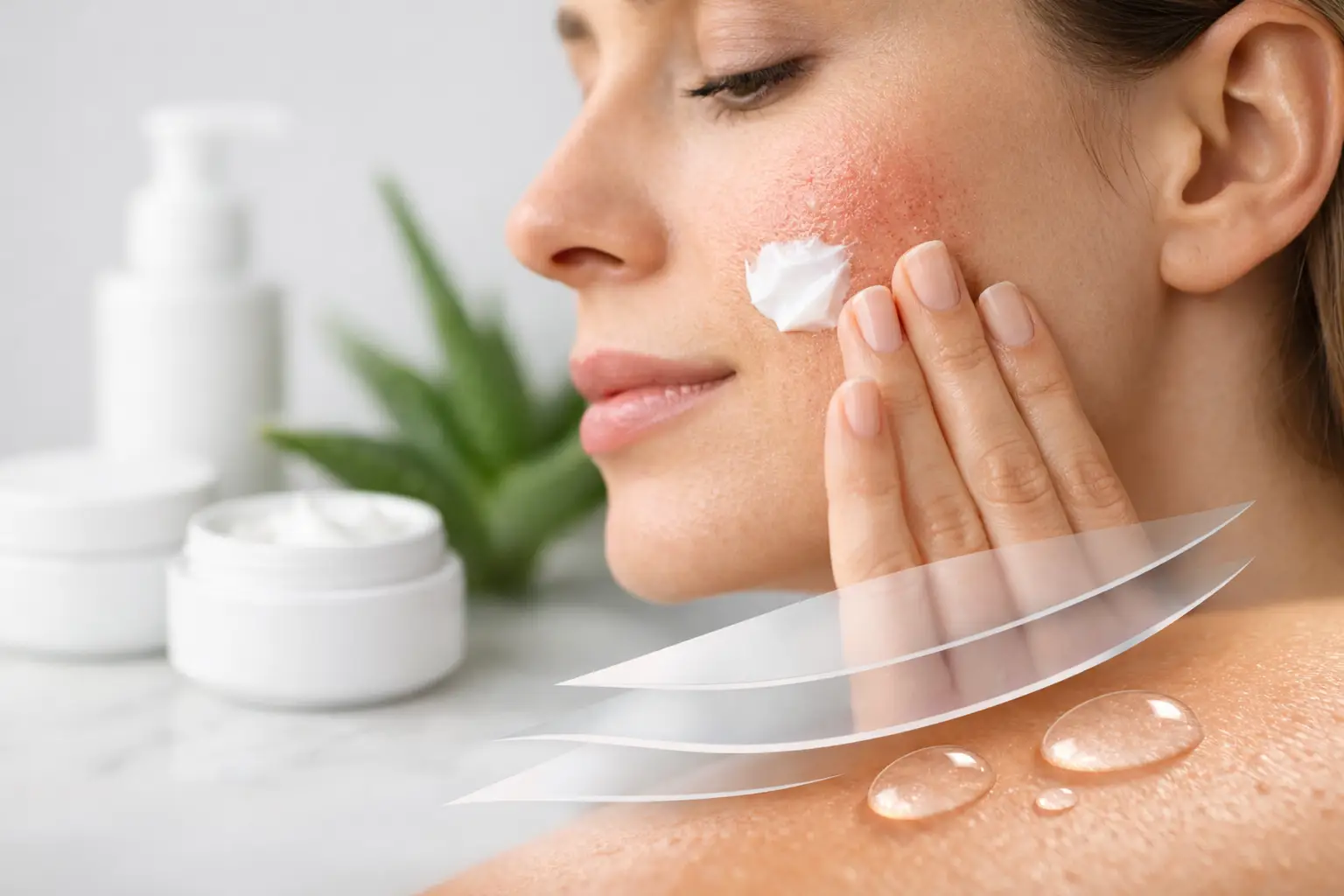
When your skin stings after water, reacts to products labeled gentle, or flares from what looks like a minor change in weather, the problem is often less about finding something new and more about stopping what keeps the barrier from recovering. Barrier repair for eczema prone skin is usually a process of subtraction before it becomes a process of support.
Eczema-prone skin is not simply dry skin. Dry skin lacks oil or water. Eczema-prone skin has a more unstable barrier, which means it loses moisture more easily and lets irritants in faster. That is why the same product that feels fine on one person can burn, itch, or trigger redness on another. The skin is not asking for more activity. It is asking for less disruption.
What barrier repair actually means
The skin barrier is the outermost protective layer of the skin. It helps keep water in and irritants, allergens, and microbes out. In eczema-prone skin, this layer is often weakened by a combination of genetics, inflammation, over-cleansing, climate, friction, and unsuitable products.
Barrier repair does not mean making skin perfect or permanently reaction-proof. It means supporting the barrier so it can function with fewer interruptions. In practical terms, that usually looks like less tightness after washing, fewer random flares, less visible scaling, and skin that tolerates a simple routine more consistently.
That distinction matters because barrier repair is often marketed as a quick transformation. In reality, it is cumulative. A barrier can improve within days, but more stable skin usually comes from repeated, low-irritation care over weeks.
Barrier repair for eczema-prone skin starts with fewer variables
If your routine includes multiple serums, exfoliants, actives, and fragrance-heavy products, it becomes difficult to know what is helping and what is quietly keeping skin inflamed. Eczema-prone skin benefits from controlled conditions. Fewer steps. Fewer formula changes. Fewer opportunities for irritation.
That does not mean every natural ingredient is automatically suitable, and it does not mean every synthetic ingredient is a problem. What matters is compatibility, concentration, and total formula design. Essential oils, botanical extracts, strong acids, and heavily fragranced products can all be too much for a compromised barrier, even when they are positioned as clean or soothing.
For many people, the most effective reset is a tightly edited routine: a mild cleanser if needed, a barrier-focused moisturizer, and daily sun protection when skin can tolerate it. If the skin is actively flaring, even water-only cleansing in the morning may be enough.
The ingredients that tend to help most
A strong barrier repair product usually focuses on replacing what the skin is missing and reducing water loss. The most useful ingredients tend to fall into three groups: humectants, emollients, and occlusives.
Humectants such as glycerin attract water to the skin. They help reduce that papery, dehydrated feeling, but they work best when paired with ingredients that prevent moisture from escaping.
Emollients help smooth the spaces between skin cells and improve flexibility. Depending on the formula, these may include fatty acids, squalane, or certain plant oils chosen for their stability and skin compatibility.
Occlusives create a protective layer that slows transepidermal water loss. Petrolatum is one of the most effective, though some people prefer lighter textures for climate or sensory reasons. In humid places like Malaysia and Singapore, a very heavy occlusive may feel uncomfortable during the day but still be useful at night or on localized dry patches.
Ceramides, cholesterol, and fatty acids deserve special attention. These lipids are naturally present in healthy skin barriers, and formulas that combine them well can be especially helpful for eczema-prone skin. Not every good moisturizer contains all three, but the logic is sound: replenish structural lipids instead of relying only on surface softness.
Colloidal oatmeal can also be useful. It is well established for soothing itch and supporting compromised skin. Panthenol and allantoin may help reduce discomfort too. The right formula is often less about a long ingredient list and more about whether each ingredient has a clear purpose.
Cleansing is where many routines go wrong
People often focus on moisturizers and ignore the step that may be causing the most damage. Harsh cleansing can strip lipids, raise irritation, and leave eczema-prone skin more reactive for the rest of the day.
A cleanser for barrier repair should remove sweat, sunscreen, and daily buildup without leaving the skin tight. Low-foam or cream cleansers often work better than strong gel cleansers, though texture alone is not a guarantee. If your face feels squeaky, the cleanser is probably too aggressive.
Hot water is another common issue. It can feel relieving in the moment, especially when skin is itchy, but it often worsens dryness afterward. Lukewarm water is the safer choice.
Frequency matters too. If you are cleansing twice a day out of habit rather than need, consider whether one proper cleanse at night is enough. Less contact, less friction, less surfactant exposure – sometimes that is the difference between skin that stabilizes and skin that keeps cycling through irritation.
How to build a routine that supports repair
Barrier repair routines work best when they are boring in the best sense of the word. Consistent. Measured. Easy to repeat.
Start with a gentle cleanse only when necessary. Apply moisturizer onto slightly damp skin to help hold onto water. If certain areas crack, peel, or sting more than others, seal those spots with a heavier balm or ointment.
If you use prescription eczema treatments, moisturize consistently around that plan rather than replacing it. Barrier care is supportive, not competitive. Many people need both anti-inflammatory treatment during flares and barrier-focused maintenance between them.
Sunscreen is more complicated for eczema-prone skin because many formulas can sting. Still, UV exposure can worsen inflammation and post-flare sensitivity. Mineral and hybrid sunscreens are often better tolerated, but this varies. The best approach is to patch test and favor simpler formulas over trend-driven ones with multiple active extras.
What to avoid while skin is trying to recover
During barrier repair, restraint is usually more useful than ambition. Exfoliating acids, retinoids, strong vitamin C formulas, peel pads, and scrubs can all wait. Even if your skin used to tolerate them, a compromised barrier changes the rules.
Fragrance is another frequent issue, especially in leave-on products. This includes both synthetic fragrance and fragrant essential oils. Some people tolerate small amounts, but if your skin is already unstable, there is little benefit in asking it to manage extra exposure.
Be cautious with over-layering. Five calming products do not necessarily calm skin more than one well-designed moisturizer. They may simply increase the chance of irritation.
Why climate and lifestyle change the answer
Barrier repair for eczema-prone skin is not identical in every environment. Humidity, air conditioning, sweat, hard water, and frequent showering all affect what skin needs.
In humid climates, lighter emulsions may be more wearable during the day, while richer creams or ointments make sense at night. In drier indoor conditions, especially with constant air conditioning, skin may need more occlusive support than expected. If you live between seasons or travel often, your routine may need small adjustments rather than a full overhaul.
Fabric friction matters too. Rough towels, tight clothing, and repeated rubbing can prolong irritation. So can long showers and heavily fragranced laundry products. Skincare helps, but skin does not exist in isolation from the rest of the routine around it.
When barrier repair is not enough on its own
There is a limit to what over-the-counter skincare can do. If the skin is cracked, weeping, infected, intensely itchy, or not improving despite a careful routine, it is time for medical support. Eczema is an inflammatory condition, not just a cosmetic concern.
This is also why exaggerated claims are not useful. No moisturizer can promise to stop every flare. What a good barrier-support routine can do is reduce avoidable triggers, improve comfort, and help skin become more resilient over time.
For many adults, that is the real goal. Not flawless skin. Just skin that feels calmer, behaves more predictably, and requires less negotiation every morning and night.
A disciplined routine may look modest on the shelf, but that is often its strength. Fewer variables. Clear purpose. Long-term support. If your skin is eczema-prone, barrier repair is rarely about doing more. It is about choosing what your skin can keep saying yes to.
Leave a Reply