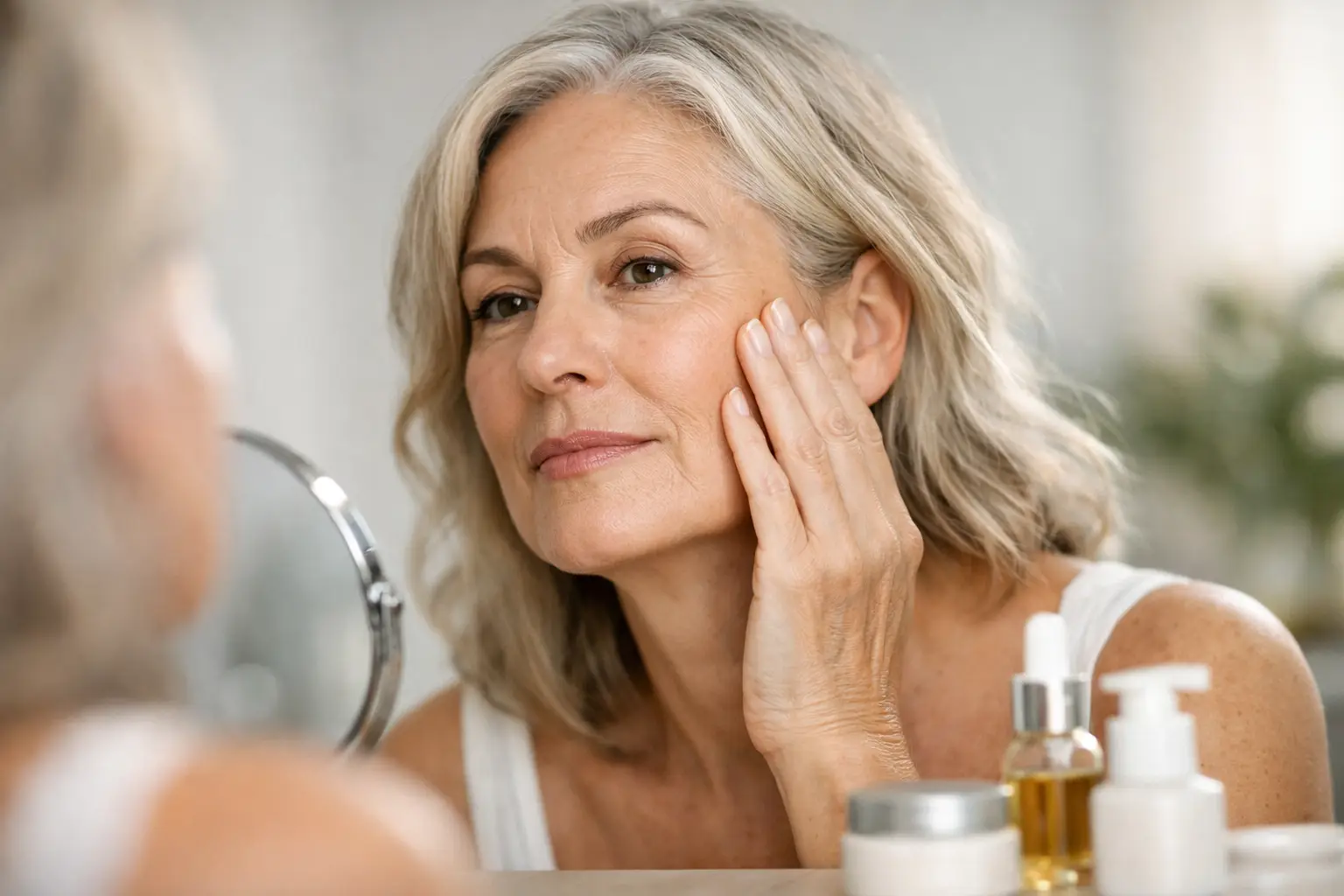
Skin can change quickly around menopause, and not always in the ways people expect. One month your usual moisturizer feels adequate. The next, your skin feels thinner, drier, more reactive, or suddenly prone to breakouts along the jawline. A good guide to menopausal skin changes should start there – with the reality that this shift is common, biologically driven, and often made worse by doing too much.
Menopausal skin does not need a dramatic routine. It usually needs a more disciplined one. Hormonal change affects oil production, collagen, barrier strength, wound healing, and pigmentation. That means the skin you knew at 40 may not behave the same way at 50, even if your environment and habits have stayed relatively stable.
What changes during menopause
Estrogen plays a meaningful role in skin function. As levels decline through perimenopause and menopause, the skin tends to produce less oil, lose water more easily, and recover more slowly from irritation. Collagen and elastin also decline, which can make skin feel less firm and more fragile.
In practice, this often shows up as dryness that seems resistant to your old products, tighter-feeling skin after cleansing, a rougher texture, and increased sensitivity. Some people also notice more visible pores, uneven tone, deeper fine lines, or redness that lingers longer than it used to.
Not every change happens to every person. Menopausal skin is not one category. Someone with a long history of oily or acne-prone skin may still get breakouts, but also develop dehydration and irritation at the same time. Someone with eczema-prone skin may find that flares become easier to trigger and harder to calm.
A practical guide to menopausal skin changes
The most useful way to understand menopausal skin is to think in terms of function, not trends. What is the skin struggling to do well now? Usually the answer is some combination of holding moisture, tolerating actives, maintaining firmness, and repairing itself after stress.
That shift matters because it changes how products should be chosen. If your skin barrier is less resilient, adding stronger acids, retinoids, scrubs, or multiple treatment serums can create more inflammation than improvement. Menopausal skin often responds better to fewer steps with clearer purpose.
Dryness is one of the most common complaints, but it can be misunderstood. Dry skin lacks oil. Dehydrated skin lacks water. During menopause, many people experience both. Skin may feel flaky at the cheeks but still look shiny by midday. That does not always mean you need a lighter routine. It may mean the skin barrier is disrupted, so water escapes and the surface becomes unbalanced.
Sensitivity also becomes more common. Products that once felt neutral may sting. Fragrance, harsh surfactants, exfoliating acids, and high-strength actives can become harder to tolerate. This is not a sign that your skin has become weak. It is a sign that its recovery capacity has changed.
Then there is texture and laxity. Lower collagen can make the skin look less dense and more creased, particularly around the mouth, eyes, and jaw. This tends to happen gradually, but the visible shift can feel abrupt. Topical skincare can support the skin, though it will not fully replace structural changes driven by hormones and time. A realistic routine improves comfort, texture, and appearance. It does not need to promise reversal.
The skin concerns that often overlap
Menopause rarely brings one neat issue at a time. Dryness may sit next to breakouts. Redness may appear alongside dullness. Hyperpigmentation can become more obvious as the skin thins and cumulative sun exposure shows more clearly.
Acne during menopause is especially frustrating because the usual acne playbook can be too harsh. Strong foaming cleansers, daily exfoliation, and aggressive spot treatments may reduce oil in the short term but leave the skin more inflamed overall. If breakouts are paired with tightness or stinging, the barrier usually needs attention first.
Pigmentation also deserves a measured approach. Sun exposure remains a major factor, and hormonal shifts can make uneven tone more noticeable. But chasing discoloration with too many brightening products at once often backfires. Irritation itself can worsen pigmentation, especially in skin that is already reactive.
For readers in Malaysia, Singapore, and Japan, climate can complicate this picture. Heat and humidity may increase sweat and surface oil, while indoor air conditioning can still leave skin dehydrated. This is one reason menopausal skin can feel both oily and dry at once. Texture alone is not the best guide. Skin behavior over the full day is more useful.
What to prioritize in a routine
Start with cleansing. A cleanser should remove sunscreen, sweat, and daily buildup without leaving the skin tight. If your face feels stripped after washing, that is not a small issue. It often sets up the rest of the routine to fail.
Moisturizing matters more during menopause, but heavier is not always better. The goal is not simply a thick layer. The goal is support for a weaker barrier. Look for formulas that help reduce water loss and keep irritation low. In practical terms, that often means bland, functional moisturizers rather than highly fragranced or trend-driven creams.
Actives still have a place, but the threshold for excess is lower. Retinoids can support texture and fine lines, but they may need to be used less frequently than before. Exfoliating acids can help with roughness and tone, but they are not always necessary, and daily use is often too much for skin that is already dry or sensitive. If you are using both and your skin is uncomfortable, scaling back is not a setback. It is usually the more effective decision.
Sun protection becomes even more important as skin becomes more prone to pigmentation and collagen loss. The best sunscreen is the one you can wear consistently without irritation. If a formula pills, stings, or feels suffocating, it is less likely to become a stable habit.
Ingredients that tend to make sense
Menopausal skin often benefits from humectants, emollients, and barrier-supportive ingredients that focus on water balance and skin comfort. Glycerin, hyaluronic acid, ceramides, squalane, panthenol, and colloidal oat are all examples of ingredients with clear practical roles.
That said, ingredient lists are not a ranking system. A product can contain the right ingredients and still be poorly suited to sensitive skin because of fragrance, essential oils, or an overall formula that is too active. Function matters more than buzzwords.
For fine lines and uneven texture, retinoids can help, but start lower and slower than beauty culture often suggests. For dullness or pigmentation, gentle brightening ingredients may be useful, but one targeted product is usually enough. A crowded routine creates too many variables and too many chances for irritation.
This is where a minimalist approach earns its place. Fewer, better products make it easier to see what is helping, what is not, and what your skin can realistically tolerate over time.
What not to do when skin starts changing
The most common mistake is reacting to every new symptom with a new product. Dryness gets a rich cream. Breakouts get an acid. Dullness gets vitamin C. Sensitivity gets another serum marketed as calming. Within a few weeks, the routine is larger, not smarter.
A better response is to reduce noise. Keep the basics steady for a few weeks: gentle cleanse, moisturize, protect, and only then add one treatment if needed. Menopausal skin usually responds better to consistency than intensity.
It is also worth resisting the idea that discomfort is proof a product is working. Tingling, burning, and persistent redness are not signs of progress. They are signs to stop and reassess.
If your skin changes are severe, sudden, or affecting quality of life, it may be worth speaking with a dermatologist or physician. Skincare can support the surface well, but not every issue should be managed by cosmetics alone.
The long view on menopausal skin
A guide to menopausal skin changes should leave room for realism. Skin at this stage may need more support, but it does not need to be treated as a problem to fix. It needs routines built around function, tolerance, and long-term use.
That often means accepting a quieter kind of progress. Less tightness after cleansing. Fewer random reactions. Better hydration by evening. Breakouts that heal without leaving the skin raw. Texture that feels steadier month to month. These are meaningful results.
If your skin has become harder to read, simplify first. Choose products with a clear role. Give them time. Menopause asks for a more intentional relationship with skin, and that is not a loss. It is often the point where less becomes more useful.
Leave a Reply