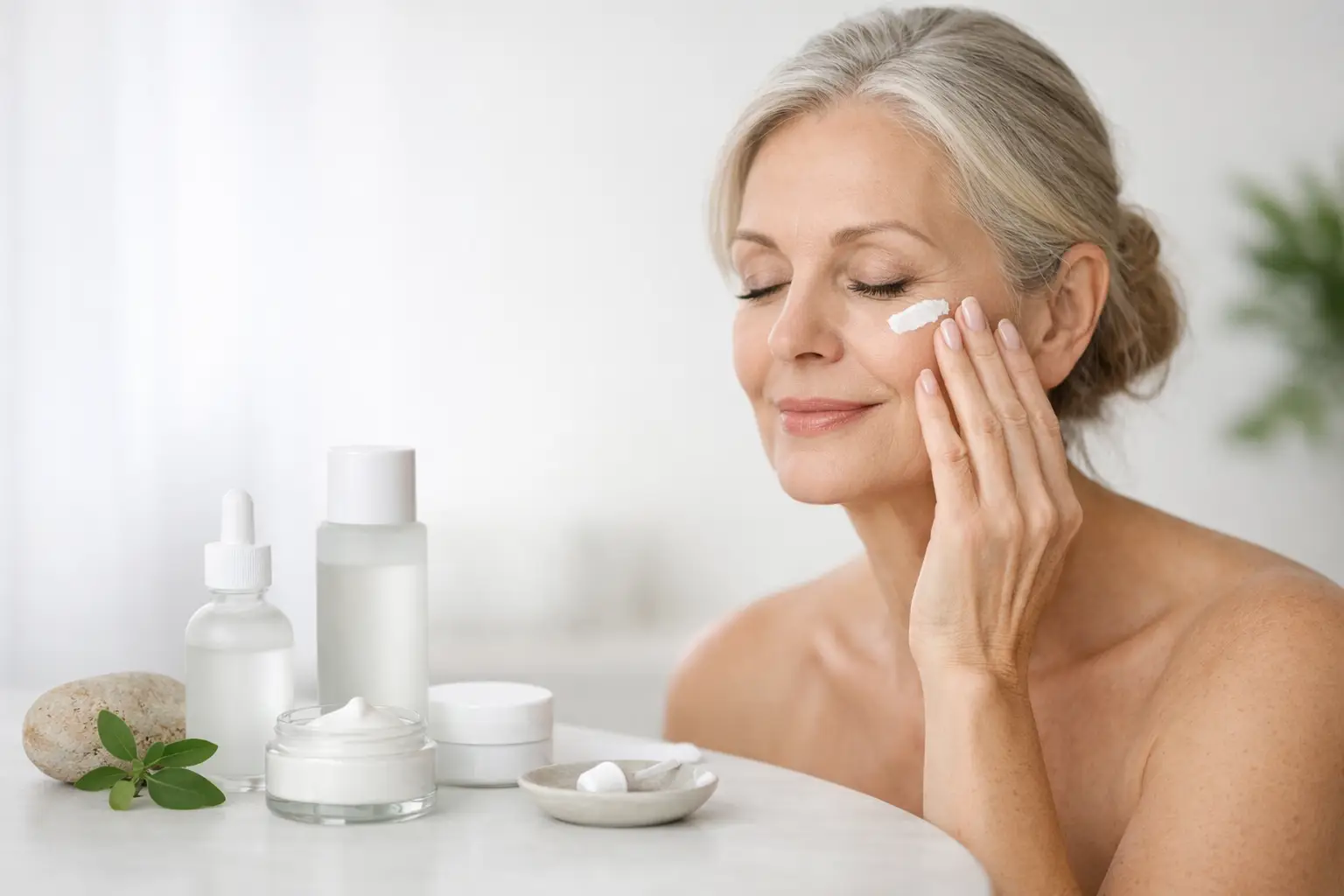
Aging skin often does not need more effort. It needs less friction, fewer variables, and products that do their job without creating new problems. That is the case for minimalist skincare for aging skin – a routine built around barrier support, hydration, and consistency rather than novelty.
For many people, the turning point comes after trying too much. A crowded routine may promise firmness, brightness, smoother texture, and fewer lines all at once, yet the result is often irritation, tightness, or skin that feels increasingly reactive. As skin matures, that trade-off becomes harder to ignore. The goal shifts from chasing every claim to protecting function.
Why minimalist skincare for aging skin makes sense
Aging skin changes in ways that are predictable, even if the timeline differs from person to person. It may produce less oil, lose water more easily, recover more slowly, and become more prone to visible dryness or irritation. Around menopause, these shifts can become more noticeable. Skin may suddenly feel thinner, less resilient, and less tolerant of products that once seemed fine.
That is why a minimalist approach is not about doing the bare minimum for the sake of it. It is about reducing unnecessary exposure to potential irritants while keeping the steps that matter. Fewer products can mean fewer fragrances, fewer strong actives layered together, fewer texture conflicts, and fewer chances to disrupt the barrier.
There is also a practical benefit. A smaller routine is easier to maintain. And with aging concerns, consistency usually matters more than intensity. Skin tends to respond better to a routine you can repeat every day than to an ambitious plan you abandon after two weeks.
What aging skin actually needs
Most aging skin routines work best when they focus on three priorities: cleansing without stripping, moisturizing with intention, and protecting skin from daily environmental stress. Beyond that, one well-chosen treatment product can be useful if your skin tolerates it.
Hydration matters because mature skin often loses water more easily. But hydration alone is not enough. Skin also needs support to hold that hydration, which is where barrier-minded formulas become important. A moisturizer should not just feel rich. It should help reduce dryness and discomfort over time.
Protection matters because visible aging is not only about time. Daily sun exposure has a cumulative effect on tone, texture, and firmness. If there is one non-negotiable step in a minimalist routine, it is sunscreen.
The final piece is tolerance. A product may be effective on paper, but if it leaves your skin red, stinging, flaky, or chronically unsettled, it is not helping in the way you need.
The simplest routine that still does enough
A useful minimalist routine usually has three steps in the morning and two or three at night.
In the morning, start with a gentle cleanse only if you need it. Some people with dry or sensitive aging skin do better with a rinse of lukewarm water or a very mild cleanser. If your skin feels comfortable without a full cleanse, that is a valid choice. The point is to remove what needs removing without starting the day with tightness.
Next comes moisturizer, though some people may prefer a hydrating serum under it if their skin feels persistently dehydrated. This is where discipline helps. You do not need several hydrating layers if one well-formulated product and a good moisturizer are enough.
Then apply sunscreen. Broad-spectrum daily protection is one of the few steps with clear long-term value for aging skin. A sunscreen you will actually wear every day is more useful than a theoretically perfect one that sits unopened.
At night, cleanse properly to remove sunscreen, sweat, and the day’s residue. Follow with a moisturizer that supports barrier repair and comfort. If you use a treatment step, this is the place for it.
How to choose fewer, better products
Minimalism only works when each product has a clear purpose. A cleanser should cleanse. A moisturizer should support hydration and barrier function. A treatment should target one concern without creating three more.
For aging skin, mild formulas tend to outperform harsh ones over time. Look for cleansers that leave skin comfortable rather than squeaky. For moisturizers, ingredients such as glycerin, squalane, ceramides, and fatty acids are often useful because they support hydration and barrier health without unnecessary drama.
If your skin is sensitive, eczema-prone, or newly reactive, fragrance-free options are often the safer route. Natural ingredients can be helpful, but they are not automatically gentler. Compatibility matters more than marketing language.
A treatment product needs even more restraint. Many people do well with one active, not three or four layered together. That might be a retinoid, a gentle exfoliating acid used sparingly, or a pigment-focused ingredient if uneven tone is your main concern. Which one makes sense depends on your skin behavior, not the trend cycle.
Where people overcomplicate aging skin routines
The most common mistake is stacking too many actives. Retinoids, acids, vitamin C, exfoliating toners, brightening serums, and resurfacing masks may all have a place, but not all at once. Mature skin often becomes less forgiving of excess, especially when dryness or hormonal shifts are already present.
Another mistake is treating every sign of aging as a separate problem. Fine lines, dullness, roughness, and dehydration often overlap. A stronger barrier and consistent sun protection can improve the overall appearance of skin more than a shelf full of targeted products used inconsistently.
There is also the habit of changing routines too quickly. If you introduce several products at the same time, you cannot tell what is helping and what is causing irritation. Minimalism gives you cleaner feedback. That matters.
A note on active ingredients
Minimalist skincare for aging skin does not mean avoiding active ingredients altogether. It means using them with purpose.
Retinoids remain one of the better-supported options for visible signs of aging, but they are not universally easy to tolerate. If your skin is dry, sensitive, or going through menopausal changes, lower frequency may be more realistic than nightly use. Two or three nights a week can still be worthwhile.
Exfoliating acids can improve texture, but mature skin often needs less of them than younger, oilier skin. Overuse can lead to chronic irritation that makes skin look worse, not better.
Antioxidants such as vitamin C can be helpful for some people, especially for uneven tone and environmental stress, but they are also a common point of irritation. If your skin is already doing well with a basic routine, you may not need to force this step.
The rule is simple: use the smallest number of actives that produce a clear benefit.
When minimalism needs adjustment
A stripped-back routine should still adapt to reality. In humid climates such as Malaysia or Singapore, some people may prefer lighter layers during the day and a richer moisturizer at night. In drier indoor environments or during travel, skin may need more support than usual. Minimalism is not rigid. It is selective.
The same applies to hormonal changes. Menopausal skin can become drier and more reactive quite suddenly. If that happens, the answer is often not another active serum. It is stepping back, restoring comfort, and rebuilding around gentle essentials.
This is also where a brand philosophy matters. Calmora Natural’s idea of fewer, better products is useful because it reflects how skin often behaves in real life. More options do not always create better outcomes.
A disciplined routine is easier to trust
There is a quiet advantage to a minimal routine that people often miss. It lowers decision fatigue. You do not have to negotiate with ten products every morning or wonder whether your skin is reacting to one serum or the combination of five.
That clarity builds trust. You know what each product is for. You can notice when your skin is improving. And if something changes, you have a better chance of identifying why.
Aging skin benefits from that kind of discipline. Not because it is fragile, but because it responds well to steadiness. Fewer products. Better formulas. Enough support to keep skin comfortable, functional, and resilient.
If your routine feels crowded, irritated, or harder to maintain than it should be, that is useful information. The best next step may not be adding another product. It may be removing the ones your skin never needed in the first place.
Leave a Reply