A tight, shiny feeling after cleansing. New breakouts beside dry patches. Stinging from a product that used to feel fine. These are often treated as signs that skin needs more help. Often, they are signs that it needs less interference. The question of minimalist skincare vs active overload is not about rejecting effective ingredients. It is about using them with enough discipline for skin to respond well.
For people managing acne, eczema-prone skin, dryness, oiliness, or visible changes around menopause, the answer is rarely a 10-step routine. Skin has a barrier to maintain, not a schedule to keep up with.
What Active Overload Looks Like
Active ingredients are not the problem. Retinoids, exfoliating acids, vitamin C, benzoyl peroxide, azelaic acid, and pigment-supporting ingredients can all have a clear role. They can improve a specific concern when the formula, frequency, and surrounding routine are appropriate.
Active overload happens when the total demand placed on the skin exceeds its ability to tolerate and recover. This may look like using a strong cleanser, exfoliating toner, vitamin C serum, retinoid, acne spot treatment, and fragranced moisturizer in the same week – sometimes in the same evening. Each product may be reasonable on its own. Together, they can create a routine that is too aggressive.
The result is often mistaken for a need to intensify treatment. Irritation can resemble acne. Barrier disruption can create more oil at the surface while leaving the skin underneath dehydrated. Dry, inflamed skin can make fine lines more noticeable. When the skin is reactive, adding another corrective serum is rarely the most direct answer.
More Products Do Not Mean More Coverage
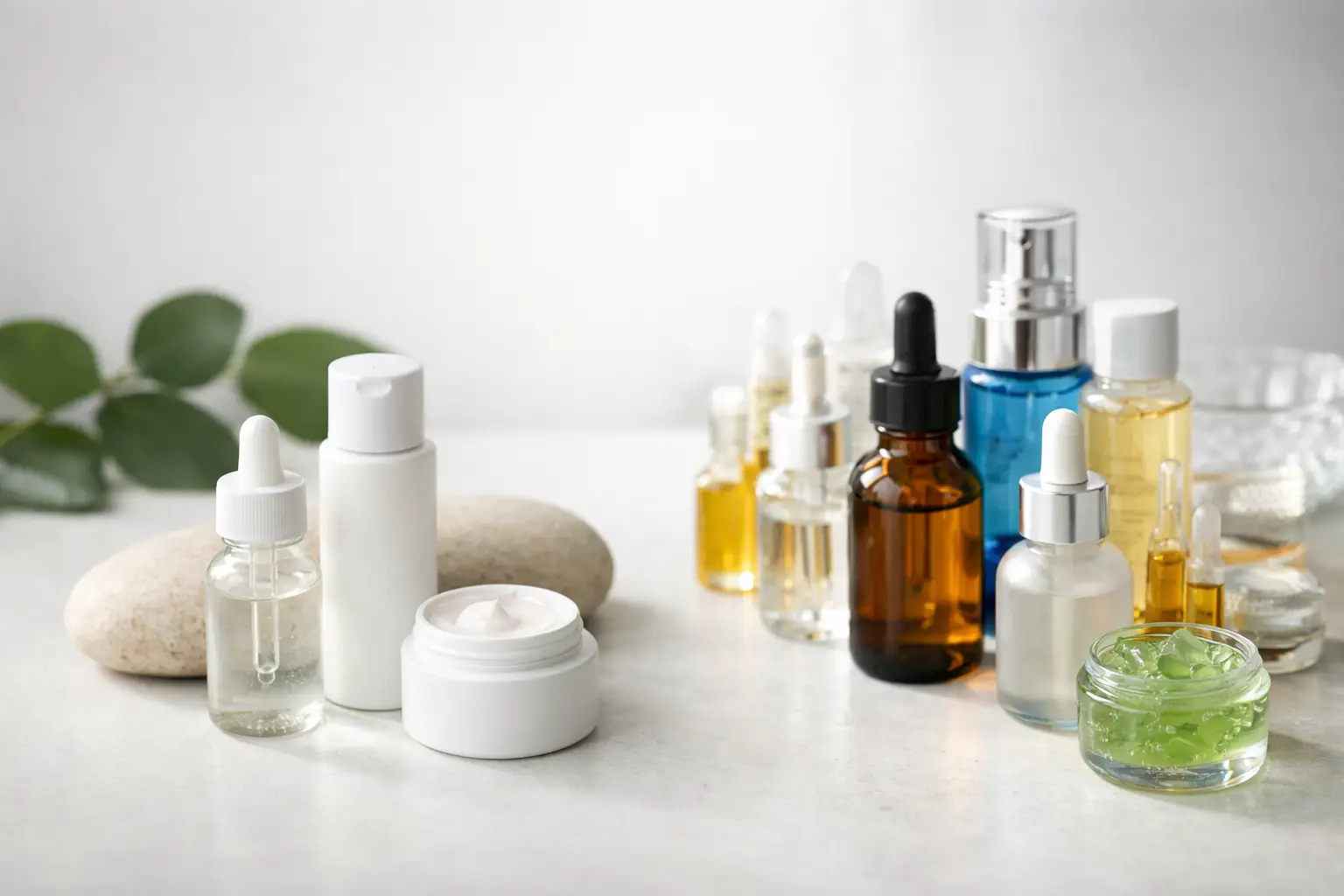
A crowded routine can feel thorough because every concern has its own product. One for pores, one for texture, one for dark spots, one for glow, one for lines. But concerns do not exist in isolation. A compromised barrier can affect acne, sensitivity, uneven tone, and visible aging at once.
This is the trade-off: more targeted products may offer more treatment potential, but they also introduce more variables. If skin becomes irritated, it becomes difficult to identify whether the cause is an ingredient, concentration, frequency, product combination, or simple overuse. Decision fatigue follows quickly.
Minimalist Skincare vs Active Overload: The Real Difference
Minimalist skincare is not a routine with the fewest possible bottles. It is a routine in which every product has a defined job, and no product is present simply because it is trending. It prioritizes cleansing that does not leave skin stripped, moisturizing that supports comfort and barrier function, daily sun protection, and one or two treatments selected for the concern that matters most.
Active overload is usually driven by accumulation. A product is added for faster results, then another is added to manage the irritation caused by the first. The routine expands, but progress becomes less predictable.
A minimalist approach accepts that skincare has limits. Acne may need consistency over several skin cycles. Dryness may improve only after repeated barrier support. Uneven tone requires protection from further sun exposure as much as treatment. This is not slow for the sake of being slow. It is a more stable way to evaluate what is actually working.
Start With a Stable Baseline
Before introducing a treatment, establish a baseline routine that your skin can tolerate every day. For many adults, this is a gentle cleanser used as needed, a well-formulated moisturizer, and broad-spectrum sunscreen during the day. The details vary with climate, lifestyle, and skin condition, but the principle holds: basic care should not create discomfort.
In humid conditions, a lighter moisturizer may be enough for oily or acne-prone skin. In air-conditioned workplaces, frequent travel, or drier seasons, the same skin may need more support. Menopausal skin may also become drier or more sensitive than it was previously. Minimalism is not rigid minimal quantity. It is appropriate care without excess.
Give this baseline time. If burning, persistent tightness, flaking, or new sensitivity continues even after simplifying, pause experimentation. Chronic eczema, severe acne, unexplained rashes, or painful skin changes deserve professional assessment rather than a longer shopping list.
Add One Active for One Priority
Once the baseline is comfortable, choose the concern with the greatest impact on your skin or confidence. If active acne is the priority, select one evidence-based acne treatment. If uneven texture is the issue, a carefully introduced retinoid or exfoliating product may make more sense. If sensitivity is already high, barrier support may be the treatment priority for now.
Introduce one new active at a time. Use it at a low, sensible frequency, then observe your skin for several weeks. Not every response is immediate. Mild, short-lived adjustment can occur with some treatments, but persistent burning, swelling, itching, cracking, or worsening inflammation is not a sign to push through.
Frequency matters as much as concentration. A lower-strength product used consistently and comfortably can be more useful than a strong formula used intermittently because it causes irritation. The best routine is not the most impressive on paper. It is the one you can maintain.
When a More Active Routine Is Reasonable
There are situations where a broader treatment plan is justified. Someone with established acne may use a prescribed treatment alongside a compatible cleanser, moisturizer, and sunscreen. A person addressing sun-related discoloration may use multiple actives at different times of day under professional guidance. The issue is not the number of products. It is whether the combination has a clear rationale.
A more active routine needs structure. Avoid introducing several new formulas at once. Separate potentially irritating treatments when needed. Keep the supporting products simple. Monitor changes in skin comfort, not just visible results.
For example, using a retinoid on selected nights while maintaining gentle cleansing and moisturizing may be appropriate. Pairing it with frequent scrubs, strong acids, and drying spot treatments without a plan is more likely to create noise than progress.
Signs Your Routine Needs Editing
Your skin does not need to look perfect to be healthy. But recurring discomfort is useful information. Consider reducing your routine if you notice persistent stinging when applying ordinary products, tightness after cleansing, peeling that does not settle, redness, sudden sensitivity, or breakouts that began after several new launches entered the bathroom cabinet.
Editing does not mean throwing everything away. First, stop the newest or strongest treatment products. Return to the products that have consistently felt comfortable. Once skin has settled, decide whether the original concern still requires treatment and whether there is a gentler way to address it.
This process can feel less exciting than buying another serum. It is also more honest. Skin improvement is often built through fewer variables, steady use, and enough time to see a pattern.
Choose Formulation Purpose Over Ingredient Hype
Ingredient awareness is useful, but an ingredient name alone cannot tell you whether a product will suit your skin. Concentration, delivery system, supporting ingredients, texture, pH, fragrance, and how often you use it all shape the experience.
Natural ingredients are not automatically gentle, and laboratory-made ingredients are not automatically harsh. Compatibility and function matter more than a simple natural-versus-synthetic label. For sensitive skin especially, a restrained formula with a clear purpose is often easier to place within a routine than a formula designed to do everything at once.
This is the value of fewer, better products. Each product should earn its place by supporting a specific need without making the rest of the routine harder to manage.
A calm routine leaves room to notice your skin rather than constantly correct it. Start with what it can tolerate, treat one meaningful concern at a time, and let consistency do the work that excess never can.
Leave a Reply