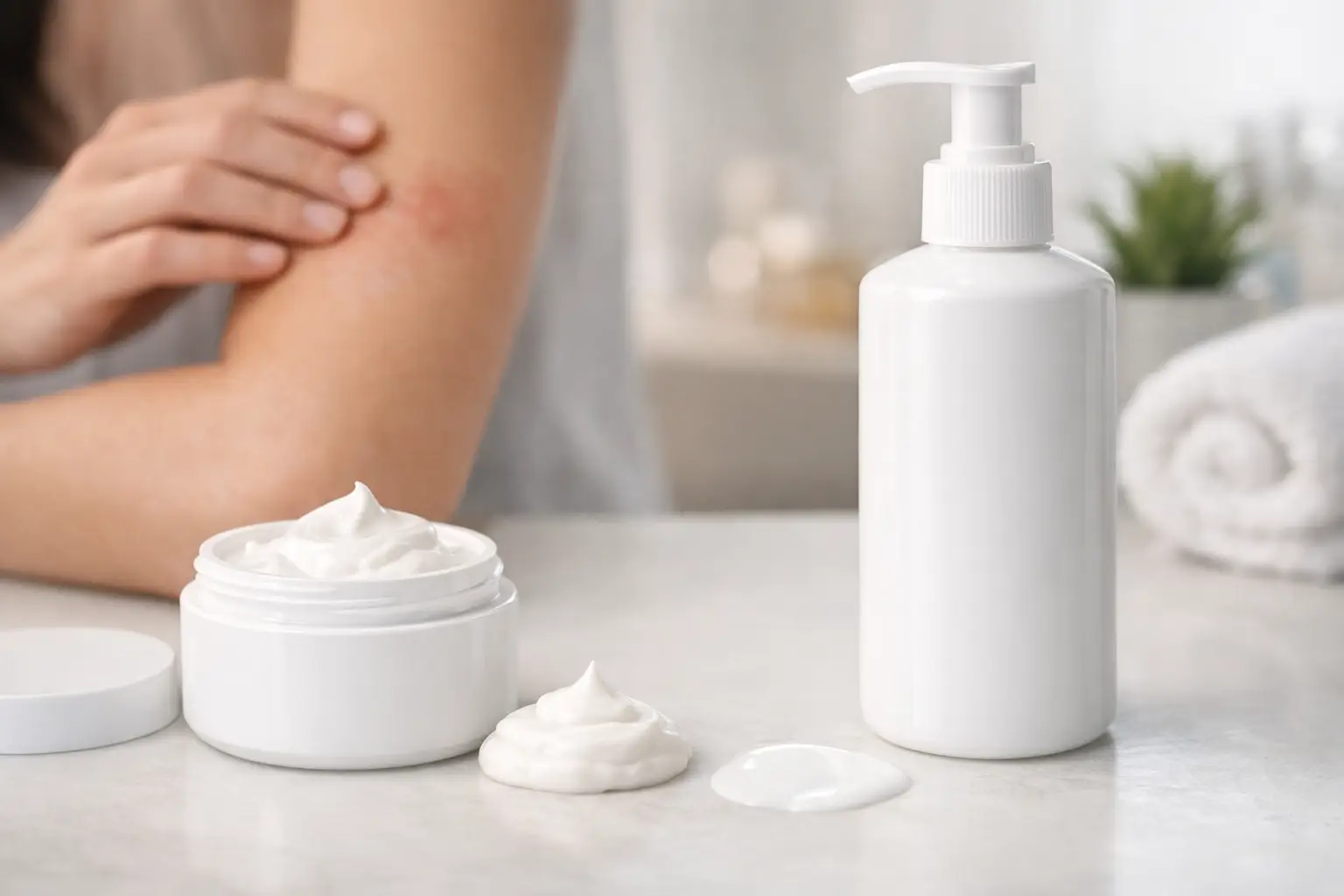
When skin is already irritated, the wrong texture can feel like an extra problem. That is why the question of eczema cream vs lotion matters more than it may seem. The difference is not just cosmetic. It affects how much moisture stays in the skin, how well the barrier is supported, and whether a product feels usable enough to apply consistently.
For eczema-prone skin, consistency is not a small detail. A product that works in theory but feels sticky, greasy, or too light often gets used irregularly. And with eczema, irregular support usually shows up quickly as dryness, itching, tightness, or a flare that takes longer to settle.
Eczema cream vs lotion: the real difference
Creams and lotions are both moisturizers, but they are built differently. A lotion usually has a higher water content and a lighter texture. It spreads easily, absorbs quickly, and tends to feel more comfortable in heat or humidity. A cream contains less water and more oil, so it is thicker, richer, and generally better at slowing water loss from the skin.
That difference matters because eczema is fundamentally a barrier problem. The skin does not hold moisture well, and it is more vulnerable to irritants. In practice, that means a cream often gives stronger support than a lotion because it leaves behind a more protective layer.
Still, thicker is not always better in every situation. The best format depends on where the eczema shows up, how dry the skin is, the climate, and whether you will actually use the product as often as needed.
Why eczema-prone skin usually needs more than a light moisturizer
Healthy skin is designed to keep water in and irritants out. Eczema weakens that system. When the barrier is compromised, the skin loses moisture faster and reacts more easily to friction, sweat, cleansing, weather changes, and fragranced or harsh products.
A lightweight lotion can add hydration, but hydration alone is often not enough for eczema-prone skin. The skin also needs help retaining that water. This is where richer textures tend to perform better. A cream can reduce transepidermal water loss more effectively than a lotion, which is often what dry, flaky, tight skin is asking for.
That said, some people avoid creams because they associate thickness with discomfort. That concern is reasonable. If a cream feels heavy during the day, especially in warm climates like Malaysia or Singapore, a lotion may be the format that gets used more consistently. The better product is the one that supports the barrier and fits real life.
When a cream is usually the better choice
Creams are often the more suitable option when eczema is active, when the skin feels rough or cracked, or when dryness returns within a few hours of moisturizing. They are especially useful on areas that lose moisture fast, such as the hands, elbows, knees, ankles, and around patches of visible irritation.
A cream also tends to make more sense at night. Skin has longer contact time with the product, and the richer texture can work without competing with humidity, clothing friction, or daytime preferences. For many adults, this is the simplest approach – lighter support in the day if needed, stronger barrier support at night.
If your skin stings easily, check the formula beyond the label. A product can be called a cream and still contain ingredients that feel active or unnecessary for compromised skin. For eczema-prone skin, restraint matters. Fragrance, high levels of essential oils, and aggressive exfoliating or anti-acne ingredients can all undermine the barrier, even in a rich base.
Signs your skin may need a cream
If moisturizer disappears too quickly, if your skin still feels tight after application, or if you wake up with flakes despite using a product the night before, a lotion may simply be too light. The same is true if you notice repeated dryness after washing your hands or showering.
In these cases, the goal is not just softness. It is longer-lasting barrier support.
When a lotion can still make sense
Lotions are not automatically the wrong choice for eczema. They are simply lighter tools. On mildly dry skin, in humid weather, or on body areas where thicker products feel uncomfortable, a lotion may be the better fit.
This is particularly relevant if the alternative is using nothing because a cream feels too heavy. A well-formulated lotion can still help maintain the skin barrier, especially when applied immediately after bathing or cleansing while the skin is still slightly damp.
Lotions are also practical for larger body areas. If you need to moisturize the arms, legs, torso, and back daily, a lighter texture can make the routine easier to maintain. For some people, that ease is what keeps the habit in place.
Signs a lotion may be enough
If your skin feels dry but not cracked, if flare-prone areas are currently calm, or if you mainly need daily maintenance between episodes of irritation, a lotion may be sufficient. It can also work well in combination with a cream – lotion for general use, cream for the driest or most reactive zones.
This kind of split routine is often more realistic than expecting one texture to do everything.
Texture matters, but formula matters more
The label tells you the format, not the quality. In eczema care, the formula behind the cream or lotion matters just as much as whether it is thick or thin.
Look for products designed to support the barrier with ingredients such as glycerin, ceramides, colloidal oatmeal, petrolatum, squalane, or other well-tolerated emollients and humectants. These ingredients help in different ways – some attract water, some soften the skin, and some help reduce moisture loss.
At the same time, be cautious with formulas that rely on sensory appeal over function. A lightweight finish can feel elegant but may not last. A rich product can feel reassuring but still include fragrant components that trigger irritation. Minimal, functional formulation is usually a better direction for eczema-prone skin than trend-driven ingredient stacks.
How to decide between eczema cream vs lotion for your routine
A useful way to choose is to think in terms of severity, body area, and timing.
If your eczema is flaring, if the skin is visibly dry, or if the area is exposed to frequent washing or friction, start with a cream. If your skin is relatively stable and you are looking for daily maintenance, a lotion may be enough, especially on larger areas or in warmer conditions.
You also do not have to commit to one format only. Many adults do better with both. Lotion can cover the whole body after a shower. Cream can be reserved for hands, patches, or nighttime repair. This is often the most efficient approach because it matches the product to the job rather than forcing one texture into every situation.
Application can change the result
Even the right product underperforms when used at the wrong time. For eczema-prone skin, moisturizers work best when applied soon after bathing, showering, or washing, ideally while the skin is still slightly damp. This helps trap water before it evaporates.
Amount matters too. Many people use too little, especially with creams. A thin layer may improve feel but not provide enough barrier support. If the skin becomes dry again quickly, the issue may be application, frequency, or both.
Reapplication is often necessary on the hands, especially after washing. That is not failure. It is simply the reality of a compromised barrier in a high-contact area.
What about ointments?
If you have tried both lotion and cream and your skin is still extremely dry, an ointment may be worth considering. Ointments are even more occlusive than creams and are often the strongest option for locking in moisture.
The trade-off is feel. Many people find them too greasy for daytime use. They can be very effective at night or on small, severely dry patches, but less practical for full-body daily wear. Again, it depends on what your skin needs and what you can realistically use.
A simpler way to think about it
The question is not which format sounds better. It is which one gives your skin enough support without creating friction in your routine. For many people, eczema cream vs lotion is really a question of barrier strength versus wearability.
If your skin is dry, reactive, or mid-flare, lean richer. If your skin is stable and you need lightweight daily maintenance, a lotion may be enough. If your needs change with season, body area, or symptom severity, your moisturizer can change too.
At Calmora Natural, that is the more useful standard: fewer products, but each with a clear purpose. For eczema-prone skin, the right choice is usually the one you can return to consistently, because steady barrier support tends to do more than chasing a dramatic result.
Leave a Reply