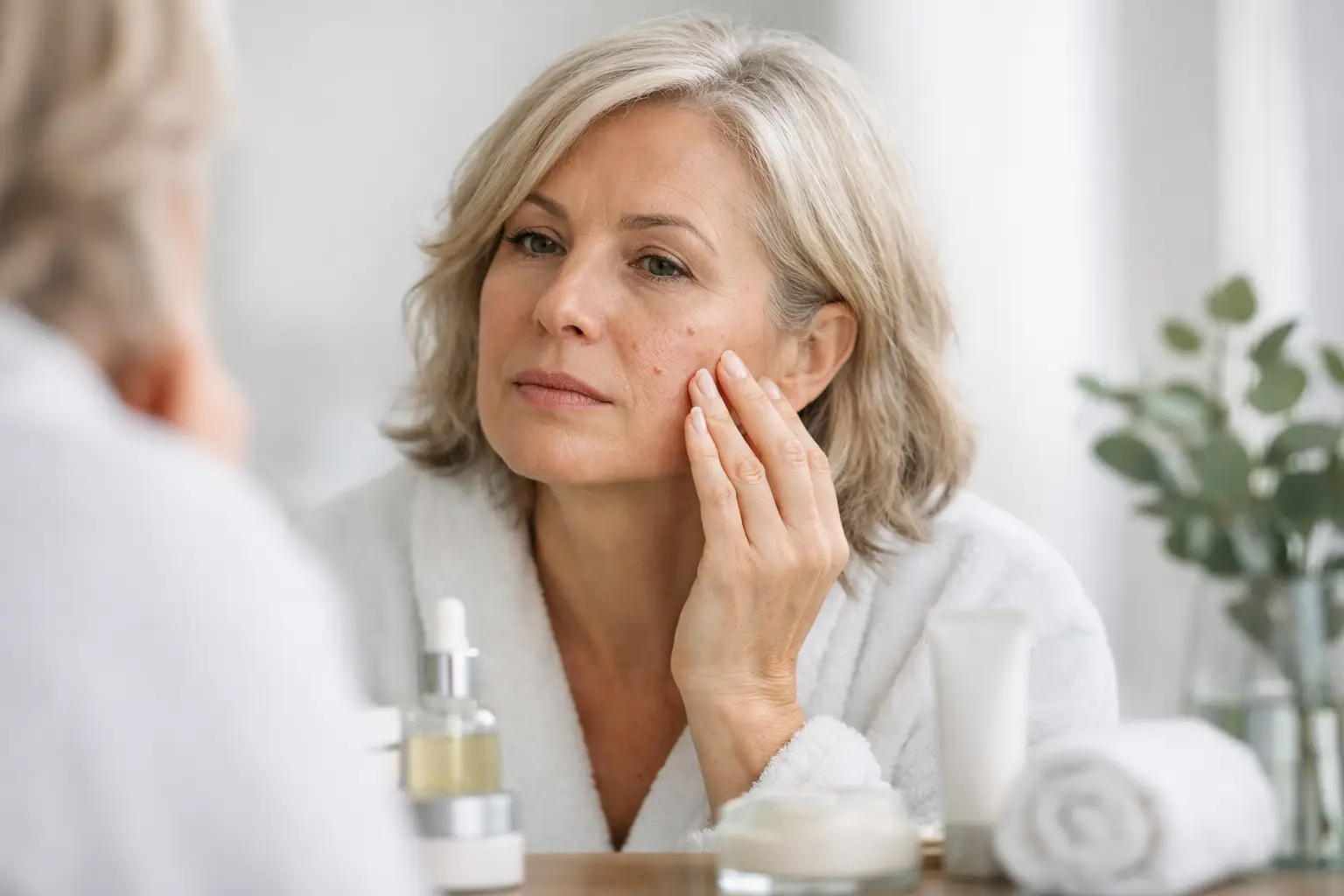
If your skin suddenly feels drier, thinner, and somehow more breakout-prone at the same time, that is not unusual. Skincare for menopause acne often needs a different approach than the routines that worked in your 20s or 30s. More stripping is rarely the answer. Skin at this stage usually responds better to less friction, fewer variables, and ingredients chosen with a clear purpose.
Menopause acne can be frustrating partly because it looks contradictory. You may see clogged pores along the jawline, chin, or lower cheeks while also dealing with tightness, flushing, or a weakened barrier. The instinct is often to treat every blemish aggressively. That can backfire quickly.
Why menopause acne behaves differently
Hormonal shifts during perimenopause and menopause can change both oil production and skin resilience. As estrogen declines, skin tends to produce less collagen and hold less moisture. At the same time, a relative increase in androgen activity can encourage clogged pores and inflammatory breakouts, especially around the lower face.
This creates a more complicated picture than classic oily teenage acne. Pores may clog more easily, but the surrounding skin is often less tolerant of harsh cleansers, frequent exfoliation, or strong spot treatments. A routine that once controlled shine can now leave skin reactive and dehydrated.
There is also a timing issue. Many people in this stage are managing several skin changes at once – breakouts, uneven tone, sensitivity, and a rougher texture. Trying to solve everything with too many actives usually leads to irritation rather than progress.
The best skincare for menopause acne starts with restraint
A useful routine for menopause acne is usually short. Not basic for the sake of being basic, but disciplined. Each product should have a reason to be there.
Start with a gentle cleanser. If your skin feels tight after washing, the cleanser may already be working against you. A low-foam or non-stripping formula is often a better fit, especially if you are cleansing twice a day out of habit rather than need. In the morning, some people do well with a simple rinse instead of a full cleanse.
Next comes treatment, and this is where moderation matters. Menopause acne often improves with ingredients that clear pores without damaging the barrier. Salicylic acid can help, but the strength and frequency matter. Used a few times a week, it may reduce congestion. Used too often, it can increase redness and dryness.
Retinoids can also be useful because they support cell turnover and can help with both acne and visible aging. But they are not automatically the first move for everyone. If your skin is already reactive, it may be better to stabilize the barrier first, then introduce a retinoid slowly. A lower-strength retinoid used two or three nights a week is often more sustainable than a strong formula used inconsistently.
Moisturizer is not optional just because you are breaking out. In fact, one of the most common mistakes in skincare for menopause acne is under-moisturizing. When skin is dry and irritated, it often becomes harder to tolerate acne treatments, and the overall texture can look worse even if breakouts are being addressed. A well-formulated moisturizer should reduce water loss, support the barrier, and sit comfortably under sunscreen.
During the day, sunscreen matters even more when you are using exfoliants or retinoids. It also helps limit the lingering discoloration that can follow breakouts. The right sunscreen is the one you will wear consistently, ideally without stinging or feeling heavy.
Ingredients worth considering
Not every helpful ingredient needs to be in the same routine. In fact, it is usually better if they are not.
Salicylic acid is useful when clogged pores and small inflamed bumps are the main issue. Because it is oil-soluble, it can move into the pore lining more effectively than many other exfoliants. For menopause acne, lower frequency often works better than daily overuse.
Niacinamide can be a practical addition when skin is dealing with multiple concerns at once. It can help support barrier function, reduce the look of excess oil, and improve the appearance of uneven tone after breakouts. It tends to fit well in minimalist routines because it is generally versatile and easy to layer.
Retinoids remain one of the more efficient long-term ingredients if your skin tolerates them. They can help with persistent acne, rough texture, and visible signs of aging, which makes them especially relevant in this stage of life. The trade-off is that they require patience and careful pacing.
Azelaic acid is often overlooked, but it can be especially useful for skin that is breakout-prone and easily irritated. It may help with inflammatory acne, post-breakout marks, and visible redness without feeling as harsh as stronger exfoliating systems.
Ceramides, glycerin, and other barrier-supportive ingredients deserve equal attention. They are not secondary. If your skin cannot maintain moisture and resilience, even well-chosen acne treatments become harder to use consistently.
What to avoid when skin is changing
The usual pattern is familiar: breakouts appear, frustration builds, and the routine expands. A stronger cleanser. A scrub. An acid toner. A spot treatment. Then a second spot treatment. Skin rarely rewards that approach.
Physical scrubs are often a poor match for menopause acne, especially if skin is also dry or sensitive. They can increase inflammation without doing much to prevent new breakouts. Highly fragranced products can also become more irritating as skin tolerance shifts.
Be cautious with layering multiple strong actives in the same routine. Salicylic acid, glycolic acid, benzoyl peroxide, and retinoids can all be useful in the right context, but not necessarily together and not always at full frequency. If your skin is stinging, peeling, or staying red for days, that is not a sign that the routine is working harder. It is usually a sign to scale back.
A simple routine for skincare for menopause acne
A practical routine often looks like this: a gentle cleanse, one leave-on treatment, a moisturizer, and sunscreen in the morning. At night, cleanse, use either your treatment or a barrier-focused serum if needed, then moisturize.
If breakouts are active and skin is sensitive, start with the lowest complexity version. That might mean a gentle cleanser, azelaic acid or niacinamide, moisturizer, and sunscreen for a few weeks. Once skin feels more stable, you can decide whether a retinoid or salicylic acid should be added.
If your main issue is clogged pores and a rough lower-face texture, salicylic acid a few nights a week may be enough. If your skin concern is a mix of acne, dullness, and loss of firmness, a carefully introduced retinoid may offer more value. If redness and irritation are constant, repairing the barrier first will usually make every next step more effective.
This is where a fewer, better products philosophy becomes useful. Menopause acne does not usually need a crowded shelf. It needs a routine that your skin can tolerate for months, not a dramatic reset that lasts six days.
When lifestyle factors matter more than another serum
Skincare helps, but it is not the whole picture. Poor sleep, high stress, frequent face touching, occlusive hair products, and inconsistent cleansing after sweating can all keep breakouts going. So can picking, which tends to cause longer-lasting marks in skin that is healing more slowly.
If you are getting persistent deep, painful breakouts along the jaw or chin, that may point to a stronger hormonal component. In that case, skincare still matters, but it may only improve part of the problem. A dermatologist can help assess whether prescription options make more sense.
You should also pay attention to pattern changes. If acne becomes sudden, severe, or unusually inflammatory, or if it appears alongside other symptoms such as noticeable hair thinning or new facial hair growth, it is worth getting medical guidance rather than endlessly changing products.
Progress should look calm, not dramatic
The most effective skincare for menopause acne usually feels almost uneventful. Less redness. Fewer new breakouts. Skin that feels more comfortable by the end of the day. A routine that does not require constant adjustment.
That slower kind of progress is easy to underestimate, especially if you have been taught to expect fast visible results. But skin in this phase often responds best to consistency, low irritation, and formulas that respect the barrier while treating congestion.
If your current routine leaves your skin confused, simplify first. Give each product a job. Keep only what is helping. Skin going through hormonal change does not need more noise. It needs support that is measured, steady, and easy to live with.
Leave a Reply