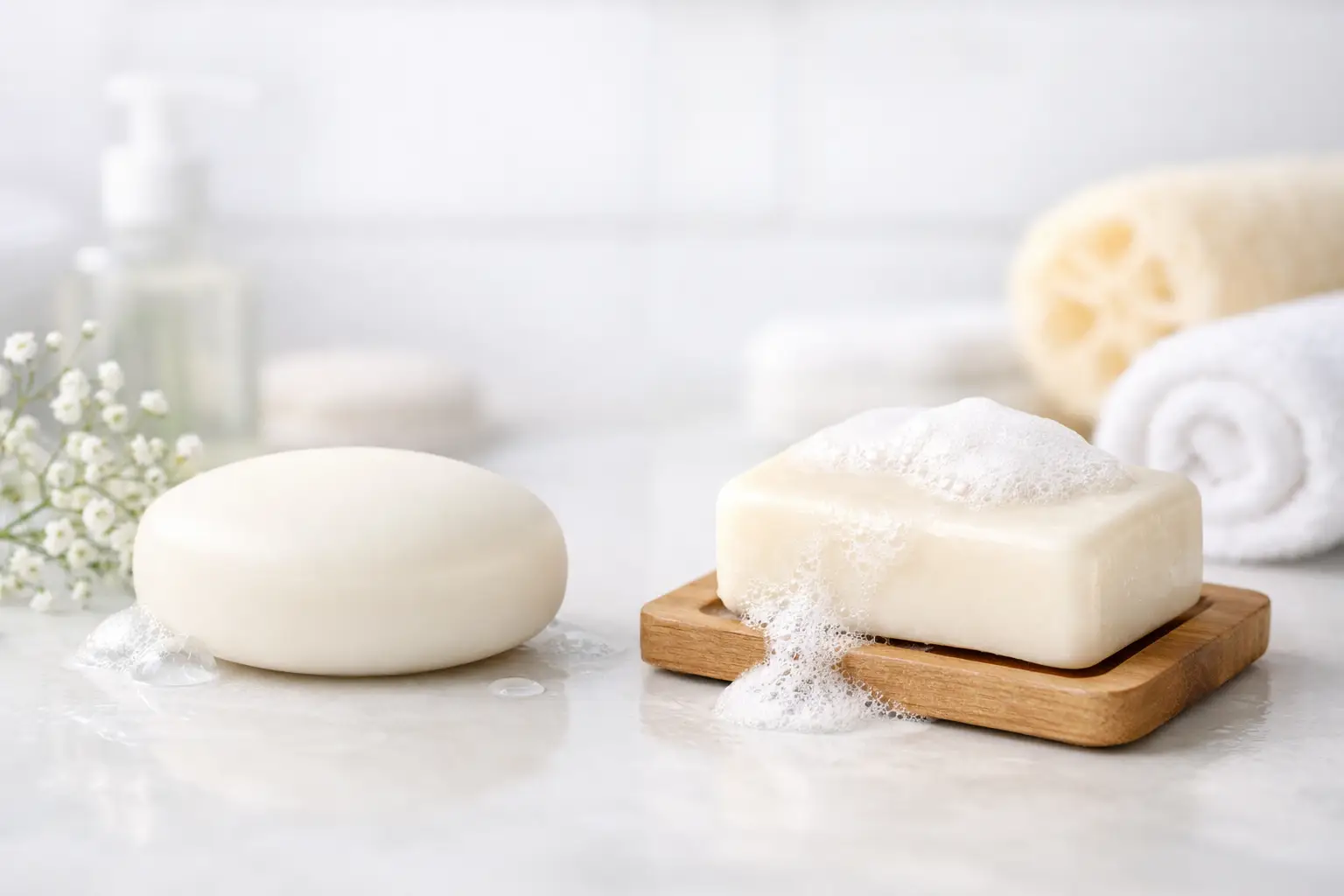
A cleansing bar can look simple while doing very different things to your skin. In the syndet bar versus soap bar decision, the useful question is not which bar sounds cleaner or more natural. It is whether its cleansing system suits your skin, your routine, and the condition of your barrier.
For skin that feels tight after showering, flares easily, or becomes unpredictable during hormonal changes, that distinction can matter more than another active serum. Cleansing is the step repeated most often. A product that removes too much, too consistently, can make every product that follows work harder.
Syndet Bar Versus Soap Bar: The Core Difference
Traditional soap is made through saponification, a reaction between oils or fats and an alkali such as sodium hydroxide. The finished bar cleans effectively because it contains soap salts that bind to oil, dirt, and debris so they can rinse away.
A syndet bar is short for synthetic detergent bar. “Synthetic” describes the cleansing chemistry, not necessarily an inferior or harsh product. Syndet bars use manufactured surfactants, often combined with fatty acids, humectants, and binding ingredients to create a solid bar. These surfactants can be selected and formulated with more control over cleansing strength, feel, and pH.
The distinction is about chemistry, not format. A bar is not automatically drying, and a liquid cleanser is not automatically mild. What matters is the surfactant system, the final pH, how often it is used, and how your individual skin responds.
Why pH Changes the Experience
Healthy skin has a naturally acidic surface, commonly referred to as the acid mantle. Its pH varies by body area and person, but it generally sits below neutral. This mildly acidic environment supports normal enzyme activity in the outermost skin layer and helps maintain an orderly barrier.
Traditional soap is generally alkaline, often with a pH around 9 to 10. This does not mean one use will damage healthy skin. Skin can recover from short-term pH shifts. But repeated exposure to an alkaline cleanser may be less comfortable for people whose barrier is already compromised or easily disrupted, including those with eczema-prone, very dry, menopausal, or reactive skin.
Syndet bars can be formulated closer to skin’s natural pH, often in the mildly acidic range. That is one reason dermatology-oriented cleansing bars are frequently syndets. A lower pH alone does not guarantee a gentle formula, but it is a meaningful part of the formulation logic.
For a person with resilient, oily body skin, a well-made soap bar may feel entirely appropriate. For someone managing persistent dryness or stinging after bathing, a pH-balanced syndet bar is often the more considered starting point.
Cleansing Power Is Not the Same as Skin Comfort
Both types of bars remove oil. The difference is how aggressively they can interact with skin lipids and proteins during washing.
Soap is efficient at lifting oils. That can be useful after heavy sweating, gardening, or washing hands repeatedly after greasy tasks. Yet this same efficiency may leave skin feeling squeaky, tight, or rough. A squeaky-clean feeling is often interpreted as proof that a cleanser worked. In practice, it can also signal that the skin’s protective surface lipids have been stripped beyond what is comfortable for your skin.
A well-formulated syndet bar can cleanse with less disruption to that surface. It may include ingredients that reduce the dry after-feel or support a softer rinse. This does not make a syndet bar a treatment for eczema, acne, or dermatitis. It is still a rinse-off cleanser. Its role is more modest and valuable: to clean without creating unnecessary friction in a routine already designed to support the skin barrier.
That principle matters when skin is under stress. If a cleanser leaves you rushing to apply lotion because your arms or legs feel uncomfortable within minutes, the product may be too demanding for daily use, regardless of how pleasant its scent or ingredient story sounds.
The “Natural” Question Needs More Precision
Soap is often presented as the more natural choice because it can be made from familiar oils such as olive, coconut, or palm. Familiar ingredients can be useful, but they do not determine how a finished cleanser behaves on skin. Coconut oil may sound nourishing, for example, while a soap bar made with a high proportion of coconut-derived soap can still be strongly cleansing.
Syndet surfactants are often derived from petroleum, plants, or a combination of sources, then processed into ingredients that perform predictably in a cleanser. Their origin is less useful than their compatibility, concentration, and final formulation.
Natural is not a reliable shortcut for mildness. Neither is synthetic a reliable shortcut for harshness. A disciplined choice looks at the finished product: Does it cleanse effectively? Is its pH appropriate for the intended use? Does it leave the skin comfortable? Are fragrance, essential oils, and exfoliating additives necessary for the person using it?
For sensitive skin, fewer variables are usually easier to evaluate. A plain, fragrance-free cleansing bar may be more useful than a bar built around color, perfume, botanicals, and a long list of claims.
Who May Prefer a Soap Bar?
A soap bar can still have a place. People with normal, resilient body skin may enjoy its firm texture, straightforward use, and clean rinse. It may also be suitable for occasional tasks where stronger degreasing is helpful, such as washing hands after cooking or cleaning tools.
Hard water can complicate the experience. Soap reacts with minerals in hard water and can form residue, sometimes called soap scum. This may make skin feel less smooth and can leave a film in showers or sinks. Syndet bars are generally less affected by hard water, which is a practical advantage in some homes.
The trade-off is that not every soap bar is equally drying. Formulas with excess oils, sometimes called superfatting, may feel less harsh than a basic soap. Still, those extra oils do not change soap’s alkaline nature. For daily facial cleansing or regular use on dry, itchy, or eczema-prone areas, many people will find a syndet bar more comfortable over time.
Who May Prefer a Syndet Bar?
A syndet bar is often a sensible option for the face, frequent handwashing, and daily body cleansing when skin is dry or sensitive. It is also worth considering if you use acne treatments, retinoids, exfoliating acids, or prescription topical treatments. These products can increase dryness or sensitivity, so a forceful cleanser may add avoidable irritation.
For acne-prone skin, do not assume a stronger cleanser will control breakouts better. Acne is influenced by several factors, including oil production, clogged pores, inflammation, and hormones. Over-cleansing can leave skin irritated and encourage an unhelpful cycle of tightness, rebound oiliness, and more product use. A gentle syndet bar can provide a stable baseline while leave-on treatments do the targeted work.
For menopausal skin, which may become drier, thinner-feeling, or more reactive, a mild cleanser is similarly practical. The aim is not to make cleansing luxurious. It is to avoid turning an ordinary daily step into a repeated source of discomfort.
How to Choose Without Overcomplicating It
Start with the area you are washing. Facial skin usually benefits from a gentler approach than hands or feet. If one bar must serve the whole household, choose based on the most sensitive regular user, then use a separate stronger cleanser only where it is genuinely needed.
Next, read beyond the front label. Terms such as “natural,” “handmade,” “detox,” or “deep clean” do not explain whether a bar is soap or syndet. An ingredient list can help. Traditional soap often lists ingredients such as sodium olivate, sodium cocoate, or saponified oils. Syndet bars may list surfactants such as sodium cocoyl isethionate, sodium lauroyl isethionate, or disodium lauryl sulfosuccinate. Names alone do not provide the whole answer, but they offer useful context.
Then pay attention to the outcome after one to two weeks of consistent use. Skin should feel clean, not coated or stripped. Watch for tightness, itching, flaking, persistent redness, or a need to apply moisturizer urgently after every wash. These signs do not diagnose a condition, but they can indicate that the cleansing step needs adjustment.
If you have active eczema, unexplained rashes, painful cracking, or persistent irritation, a cleanser change may help but should not replace medical assessment. Keep the routine simple while you seek appropriate care.
A Better Standard for Daily Cleansing
The best bar is not the one with the most romantic ingredient list or the strongest clean sensation. It is the one that fits the job without asking your skin to recover from it afterward.
For many people, especially those managing dryness, sensitivity, or a compromised barrier, a pH-balanced syndet bar offers a more controlled daily cleansing option. Soap remains useful in the right context. The practical choice is to let your skin’s comfort, not the label’s mythology, set the standard.
Leave a Reply