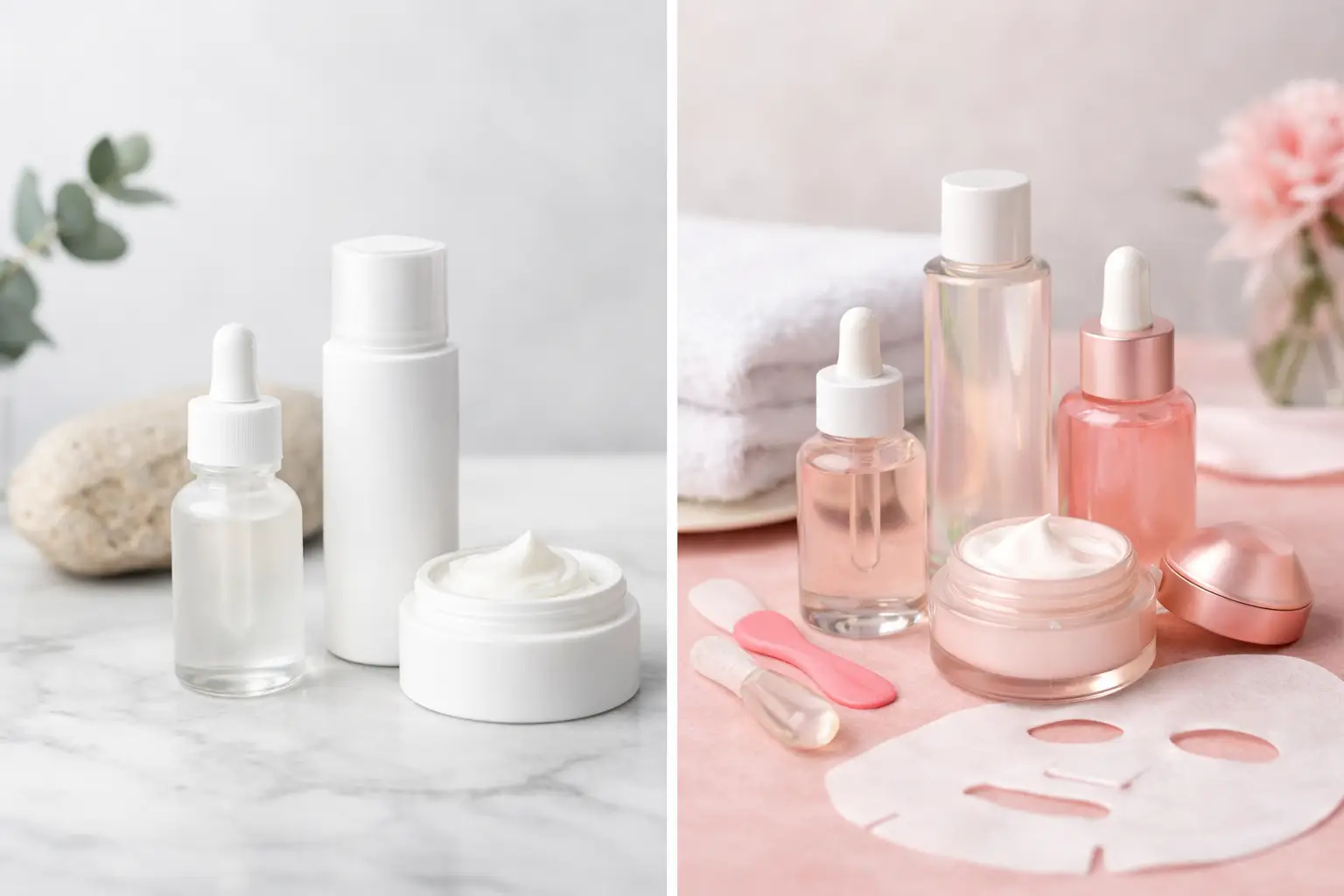
If your bathroom shelf feels like a negotiation between restraint and curiosity, this is the real question behind minimalist skincare vs korean skincare. One approach asks how little you need. The other asks how much support your skin can benefit from when each step has a clear role. Neither is automatically better. The better choice depends on your skin condition, your tolerance for trial and error, and how much complexity you can sustain consistently.
For many people, the appeal of minimalist skincare is not aesthetic. It is practical. Fewer products mean fewer variables, lower irritation risk, less spending drift, and less confusion about what is actually helping. Korean skincare, by contrast, built its reputation on layering, hydration, skin maintenance, and texture-focused formulation. At its best, it is thoughtful and precise. At its worst, it can become too many steps without a clear reason.
Minimalist skincare vs korean skincare: the core difference
The clearest difference is not East versus West or simple versus advanced. It is philosophy.
Minimalist skincare starts with necessity. The routine is built around a small number of products that meet essential functions such as cleansing, moisturizing, protecting the barrier, and treating one or two specific concerns. It favors reduction. If a product does not serve a distinct purpose, it usually does not belong.
Korean skincare starts with optimization. The routine often treats skin care as a system of small, complementary steps designed to keep skin hydrated, calm, and resilient over time. That may include double cleansing, toner, essence, serum, moisturizer, and sunscreen, with occasional masks or targeted treatments. The logic is not excess for the sake of excess. The logic is layering lighter textures to support skin gradually.
That distinction matters because people often compare the two in a superficial way. Minimalist skincare is not just using fewer products because you are tired. Korean skincare is not just doing ten steps because social media said so. In both cases, the best routines are intentional.
Where minimalist skincare works best
Minimalist skincare tends to work especially well for people with reactive, eczema-prone, acne-prone, or easily overwhelmed skin. When your skin is frequently irritated, inflamed, or unpredictable, a shorter routine gives you better control. You can identify triggers more easily. You can introduce actives more carefully. You are less likely to create problems by combining too many ingredients that all sound beneficial on their own.
This is also why minimalist routines often suit people dealing with decision fatigue. If your skin needs support but your life does not allow for seven steps twice a day, consistency matters more than ambition. A cleanser, moisturizer, and sunscreen can do far more for skin health than a complicated routine used sporadically.
There is another advantage that rarely gets enough attention: discipline. A minimalist approach forces each product to justify its place. That usually leads to better formulation standards and less tolerance for filler products that do not meaningfully change outcomes.
The trade-off is that minimalist skincare can become too restrictive when it turns into ideology. Some skin concerns benefit from more than three products. Persistent dehydration, uneven tone, post-acne marks, or menopausal skin changes may improve faster with a few targeted layers rather than one all-purpose cream expected to do everything.
What Korean skincare gets right
Korean skincare has been influential for good reason. It normalized gentle cleansing, daily sunscreen, hydration-focused routines, and a preventive view of skin care. It also pushed the market toward elegant textures that make daily use more realistic, especially for people who dislike heavy or greasy products.
For dry, dehydrated, or tight-feeling skin, Korean skincare often performs well because it does not rely only on a thick moisturizer at the end. It builds hydration through multiple lightweight layers. That can be useful in air-conditioned environments, humid climates with compromised barriers, or periods when skin feels simultaneously oily and dehydrated.
Korean skincare also tends to treat skin maintenance as a long game. Instead of chasing dramatic overnight correction, the routine often aims to keep the barrier supported so skin functions better over time. That mindset is valuable.
Still, the category is often misunderstood. A Korean skincare routine does not need to be ten steps. In reality, many well-designed routines are four to six steps, adjusted by season and skin condition. The problem starts when layering becomes automatic rather than necessary. If every new toner, ampoule, and sleeping mask is added without a clear purpose, the routine stops being precise and starts becoming noise.
Minimalist skincare vs korean skincare for sensitive skin
This is where the comparison becomes more practical.
If you have sensitive or eczema-prone skin, minimalist skincare usually offers a safer starting point. Fewer products reduce exposure to common irritants, fragrance load, preservatives across multiple formulas, and ingredient interactions that are hard to track. When skin is inflamed, the first goal is not optimization. It is stability.
That said, Korean skincare is not automatically a poor fit for sensitive skin. Many Korean formulations are gentle, fragrance-free, and barrier-focused. The issue is not origin. The issue is accumulation. Even mild products can become too much when layered carelessly.
A disciplined version of Korean skincare can work well for sensitivity if it stays focused: a gentle cleanser, one hydrating layer, a barrier-supportive moisturizer, and sunscreen. That is not far from a minimalist routine. The difference is mainly in texture strategy and layering philosophy.
So if your skin is sensitive, the question is less about choosing sides and more about choosing limits. How many steps can your skin tolerate without confusion, stinging, or congestion? Start there.
When more steps help, and when they do not
More steps help when each one solves a different problem. An oil cleanser can remove sunscreen well. A water-based cleanser can clear residue without stripping. A hydrating toner can reduce tightness. A targeted serum can address pigmentation or breakouts. A moisturizer can seal in hydration. In that context, layering is rational.
More steps do not help when products overlap heavily or when the routine keeps changing. Three hydrating toners are rarely better than one good one. Two exfoliants in the same routine are often unnecessary. Rotating too many serums makes it difficult to assess whether your skin is improving or simply cycling through irritation and recovery.
This is where a minimalist framework is useful even if you prefer Korean skincare textures. Keep the logic of restraint. Add products only when the routine has a genuine gap.
A better way to choose your routine
If your skin barrier feels compromised, your face stings easily, or you are recovering from overuse of acids or actives, start minimalist. Build around cleanser, moisturizer, and sunscreen, then add one treatment only if needed. This is often the fastest route back to predictable skin.
If your skin is stable but chronically dehydrated, dull, or uncomfortable with heavier creams, a Korean-inspired layered routine may serve you better. Not because it is more elaborate, but because lighter hydration in stages can feel more wearable and effective.
If you are acne-prone, either approach can work. What matters is whether the products are compatible with your skin and whether the routine is simple enough to stay consistent. Acne does not usually improve because a routine is trendy. It improves when cleansing is balanced, treatment is appropriate, and the barrier is not being damaged in the process.
For aging or menopausal skin, the answer is often hybrid. Skin may need richer barrier support, more hydration, and one or two targeted actives, but not a crowded shelf. This is where a fewer, better products philosophy becomes useful. You do not need a ceremonial routine. You need products with clear function and enough comfort to use every day.
The most useful middle ground
The most effective routines often sit between the two camps. Borrow the discipline of minimalist skincare. Borrow the texture intelligence and hydration strategy of Korean skincare. Keep only what your skin can justify.
That might mean four steps in the morning and four at night. It might mean three steps during flare-ups and five when skin is stable. It might mean using a Korean-style hydrating layer inside an otherwise minimalist system. Calmora Natural is built around that kind of thinking – minimal, without compromise.
The real mistake is assuming your routine has to match an identity. Skin care is not a belief system. It is maintenance. If a shorter routine keeps your skin calm, trust that. If a few carefully chosen layers make your skin more comfortable, that has value too.
Choose the approach you can repeat without friction, because the best routine is rarely the most impressive one. It is the one your skin can live with for the long term.
Leave a Reply